

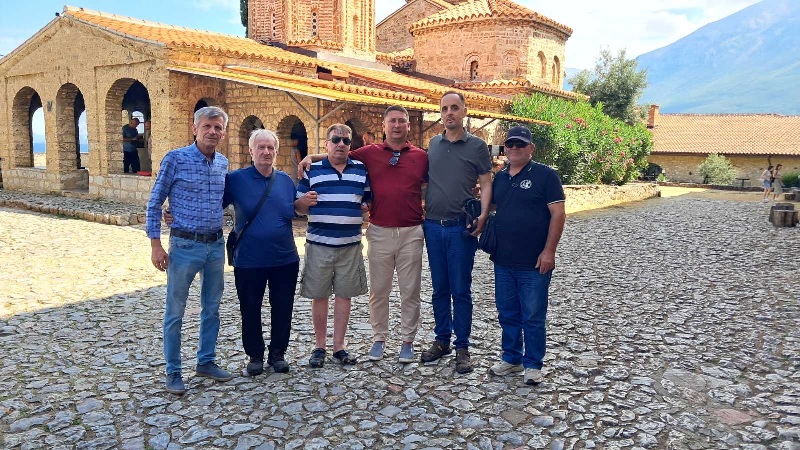
The delegation from Podgorica, which consisted of the president of the Paralympic Committee of Montenegro, Igor Tomić [Igor Tomich], and the director of the Montenegro Library for Persons with Visual Impairments, Božidar Denda [Bozhidar Dairnda], stayed at the beginning of August 2025 in Ohrid, in North Macedonia. On this occasion, the Montenegrin delegation met with representatives of the National Union of the Blind of the Republic of North Macedonia (NSSRM) and the Paralympic Committee, led by the president of the NSSRM, Žarko Selkovski [Zharkor Selkovski], and Dragan Dojčinovski [Dragan Doychinovski], the Secretary General of the Macedonian Paralympic Association.
The meeting discussed a wide range of topics of mutual interest, including cultural and sports cooperation, exchange of experiences and a number of issues related to the rights and position of visually impaired people, as well as other groups of people with disabilities in both countries.
A particularly important topic was the experiences of the Montenegrin side in connection with the establishment and functioning of the Montenegro Library for Persons with Visual Impairments (BZSCG). It was pointed out that in February 2004, the Montenegrin Government passed a decree on the establishment of the Library as a public institution and thereby undertook the obligation of its financing. This decision proved to be essential for the successful and stable operation of the institution, as it ensured continuity in development and availability of accessible formats to all users.
BZSCG, which next year marks 20 years of existence and successful work, today represents a temple of culture for visually impaired people, but also for all other users who need accessible formats. The role of the Library goes beyond the borders of Montenegro, because it has been making its funds and resources available to users from the entire region and beyond for years. Exactly this model of organization – with the founding and financial support of the state – is applied in numerous countries of the Balkans and almost all Western European countries, were libraries with accessible formats function as public institutions.
During the talks in Ohrid, through detailed analysis and deliberations, the conclusion was reached that the Government of North Macedonia should also make a decision to establish a library of accessible formats as a public institution, and to assume the role of founder and provide stable funding. In this way, relying on the support of the National Union of the Blind of the Republic of North Macedonia, it would be possible to establish the functioning of a library that would have a book collection, adequate equipment and personnel capacities, while using the experiences of the Montenegrin model.
The Director of our Library, Božidar Denda, promised all the necessary professional and technical assistance in this process, stressing that The Montenegro Library for Persons with Visual Impairments will make itself available in providing support. Also, it was agreed that until the establishment of a similar institution in Skopje, BZSCG will continue to be at the service of users from North Macedonia.
During the meeting, a number of technical, programmatic, organizational and normative issues concerning the functioning of accessible format libraries were discussed. Both parties expressed their satisfaction with the quality and content of the discussions, assessing that the meeting was very useful and important for continuing cooperation and raising it to an even higher level.
In addition to the work part of the visit, the Montenegrin delegation, thanks to the exceptional hospitality and kindness of their hosts, had the opportunity to visit numerous cultural, religious and tourist attractions of Ohrid, a city that rightly bears the epithet of one of the most beautiful cultural centres in the Balkans. The wealth of history, architecture and natural beauty contributed to the meeting gaining a special cultural and touristic dimension.
The visit of the delegation from Montenegro to Ohrid was evaluated as successful and meaningful. The talks opened the possibility for strategic improvement of cooperation in the field of culture, sports and the rights of persons with disabilities, especially in the direction of establishing a library of accessible formats in North Macedonia, following a model that has already proven successful in Montenegro.